
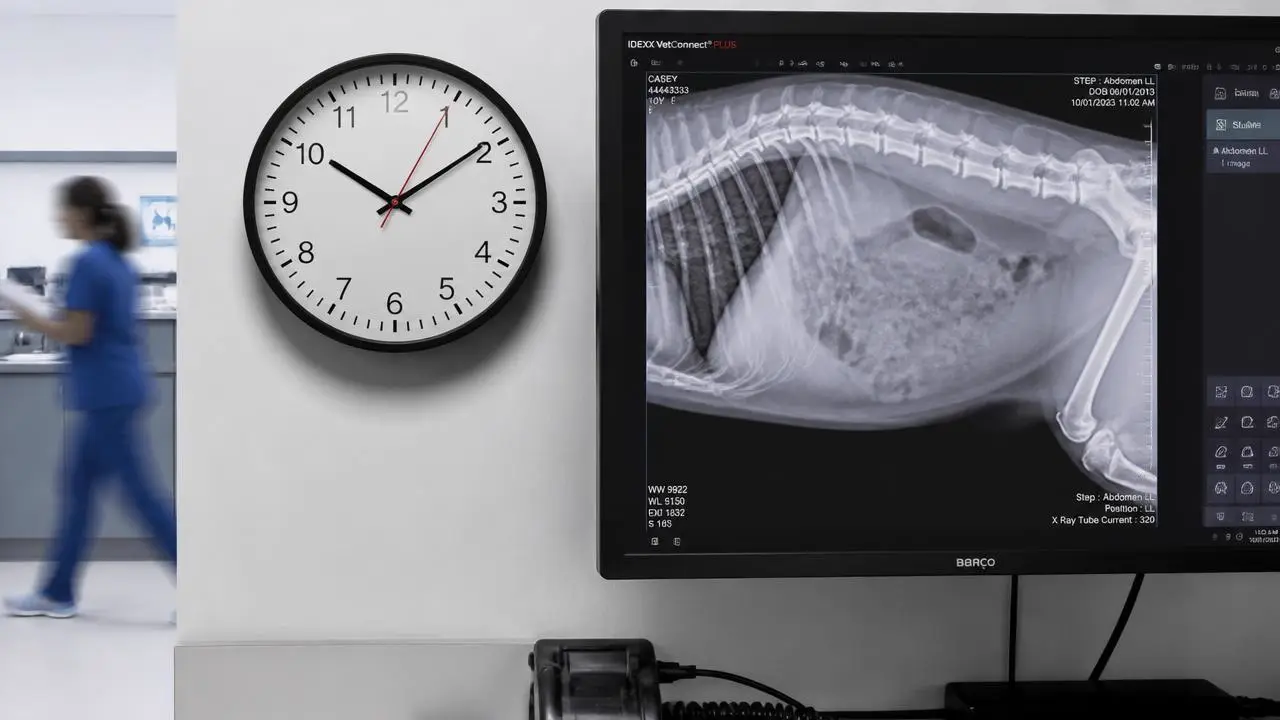
In veterinary teleradiology, speed and accuracy are always marketed together, as if they were unrelated and both simply chosen. In real operations they pull against each other, and the interesting question is not which one a provider claims, but what system they have built so that one does not eat the other.
Key takeaways
- Speed bought by cutting reading time per study is dangerous. Speed bought by queue design and staffing is not.
- Slow reads have real clinical costs that nobody puts on an invoice: extra hospitalisation, delayed surgery, repeat visits.
- Ask for the percentage of studies inside the promised window over 30 days, not the average turnaround.
- Hedged, template-heavy reports are usually a symptom of a rushed reader, a poor study, or missing history.
- A large share of your turnaround is generated in your own building, before the study ever leaves it.
Where speed and accuracy collide in veterinary teleradiology
A radiology report is produced by a finite amount of expert attention applied to a finite dataset. There are only four levers a provider can pull to go faster:
- Reduce time per study. The dangerous lever. It compresses the systematic search first, which is exactly where second findings and incidentals live.
- Add radiologists or spread them across time zones. Expensive, structural, and the one that actually works overnight.
- Improve queue design and triage. Getting the right study to the right reader in the right order, with genuine STAT separation.
- Improve input quality. Complete studies, clean DICOM, real history and a specific question. A radiologist not hunting for context reads faster and better at the same time.
Levers two, three and four buy speed without cost. Lever one buys speed by borrowing from accuracy, and the loan comes due on the case where it matters. When a provider tells you they are fast, the follow-up question is simply: which of those four?
What cheap speed costs in a veterinary radiology report
- Truncated search. The clinical question gets answered, the rest of the study gets skimmed. You will not notice this in the report; you will notice it three months later.
- Template inflation. Boilerplate normal statements padding a report that contains almost no case-specific observation.
- Comprehensive hedging. Every finding qualified into meaninglessness so nothing can be wrong. A report that cannot be wrong also cannot be used.
- No comparison to priors. The single most time-consuming and most valuable part of a follow-up read, and the first thing dropped under pressure.
What slow reports cost your veterinary clinic
The opposite failure is quieter and just as expensive. A routine study returned in 48 hours instead of 24 produces:
| Delay | Clinical consequence | Practice consequence |
|---|---|---|
| Emergency read over 2 hours | Surgical decision deferred to the next shift | Overnight hospitalisation, handover risk, owner anxiety |
| Routine read over 24 hours | Treatment started empirically or not at all | Second consultation, repeat client communication, unpaid staff time |
| Staging read delayed | Chemotherapy or surgery scheduling slips a week | Referral relationship strain |
| No prior comparison | Progression versus stability cannot be judged | An additional imaging study to answer a question that was answerable |
Free for veterinary teams
The veterinary teleradiology provider audit worksheet
The scoring sheet we would use to evaluate any teleradiology provider, including our own: the metrics to request, the questions that reveal how speed is being produced, and the report-quality checks you can run on studies you already have. Ask and we will send it.
- 12 questions, with the answers that should worry you
- The turnaround metrics to request instead of averages
- A five-point report quality rubric for your last 10 studies
No contracts. No minimums. Radiologists on shift every day of the year.
How good veterinary teleradiology providers deliver both
Providers who genuinely deliver on both sides tend to share the same unglamorous characteristics:
- Real STAT separation. An urgent case does not queue behind forty routine studies. If STAT is simply a label with no separate workflow, it is marketing.
- Coverage that matches when emergencies happen, which is overnight, weekends and holidays, not business hours with an answering service.
- Named radiologists. You know who read your study, and you can reach them. Accountability at the individual level changes behaviour in a way that aggregate metrics do not.
- A documented QA loop. Sampled peer review, a defined addendum process, and a route for the submitting veterinarian to escalate a disagreement and get a written answer.
- Investment in input quality. Providers who give feedback on your study quality are shortening their own turnaround, which is why the good ones bother.
Diplomate status through the American College of Veterinary Radiology, or the European College of Veterinary Diagnostic Imaging for European-trained specialists, is the floor, not the differentiator. Every serious provider clears it. What separates them is the operating system around the radiologist.
Signals in the reports you already have
You do not need a trial to evaluate a provider. Pull your last ten reports and score them.
| Look for | Good sign | Warning sign |
|---|---|---|
| Findings section | Case-specific observations, measurements, laterality | Generic normal boilerplate with one line of substance |
| Impression | Ranked differentials tied to the findings | A restatement of the findings in different words |
| Limitations | Explicit: what this study cannot exclude and why | Silent, implying certainty that radiographs cannot deliver |
| Recommendations | Specific and actionable next test or interval | 'Clinical correlation recommended' as the entire recommendation |
| Priors | Compared and named, with change described | No mention that priors existed |
| Clinical question | Directly answered in the first or second line | Never addressed |
A one-afternoon veterinary teleradiology provider audit
- Request the distribution, not the average. "What percentage of STAT studies in the last 30 days were delivered within 60 minutes, and what was the slowest?"
- Ask who reads overnight, by name and by coverage model. Contracted overflow at 3am is not the same thing as staffed overnight coverage.
- Ask how a disagreement is handled, and what the written turnaround for a review is.
- Ask what proportion of studies get peer reviewed, and whether the reviewer knows whose study it is.
- Ask about contracts and minimums. A provider that needs to lock you in is managing caseload risk with your money. No contracts and no minimums is not a perk, it is a statement of confidence.
- Score your last ten reports against the table above and compare.
The half of turnaround time you control in your clinic
Turnaround starts when the study arrives, and a substantial share of the elapsed time in a typical case is generated before that. The reliable accelerators are all at your end:
- Complete views the first time, so the report is not a request for more images.
- Full DICOM rather than exported JPEG, so windowing is possible.
- Signalment, duration, exam findings, medications and prior imaging.
- A specific question. "Assess for mechanical obstruction" rather than "vomiting". The acute abdomen guide shows how much a precise question changes the read.
- Priors attached, or at least named, so comparison is possible.
STAT discipline for veterinary teleradiology
A STAT queue only works if STAT means something. Practices that flag everything urgent eventually get the turnaround of a practice that flags nothing. A workable rule: STAT is for cases where a decision in the building is waiting on the read. Everything else is routine, and routine within 24 hours is fast enough for the medicine it supports.
If you are deciding between providers, or between imaging tests, the companion pieces are our case for a second reader and the modality selection guide. If you would rather just test the claim, send us one study you already have a report for and compare, or speak to a radiologist before your next scan.
Frequently asked questions
Work with us
Board-certified reads, 1 hour STAT, every day of the year
No contracts, no minimums, and direct access to the radiologist reading your case.