
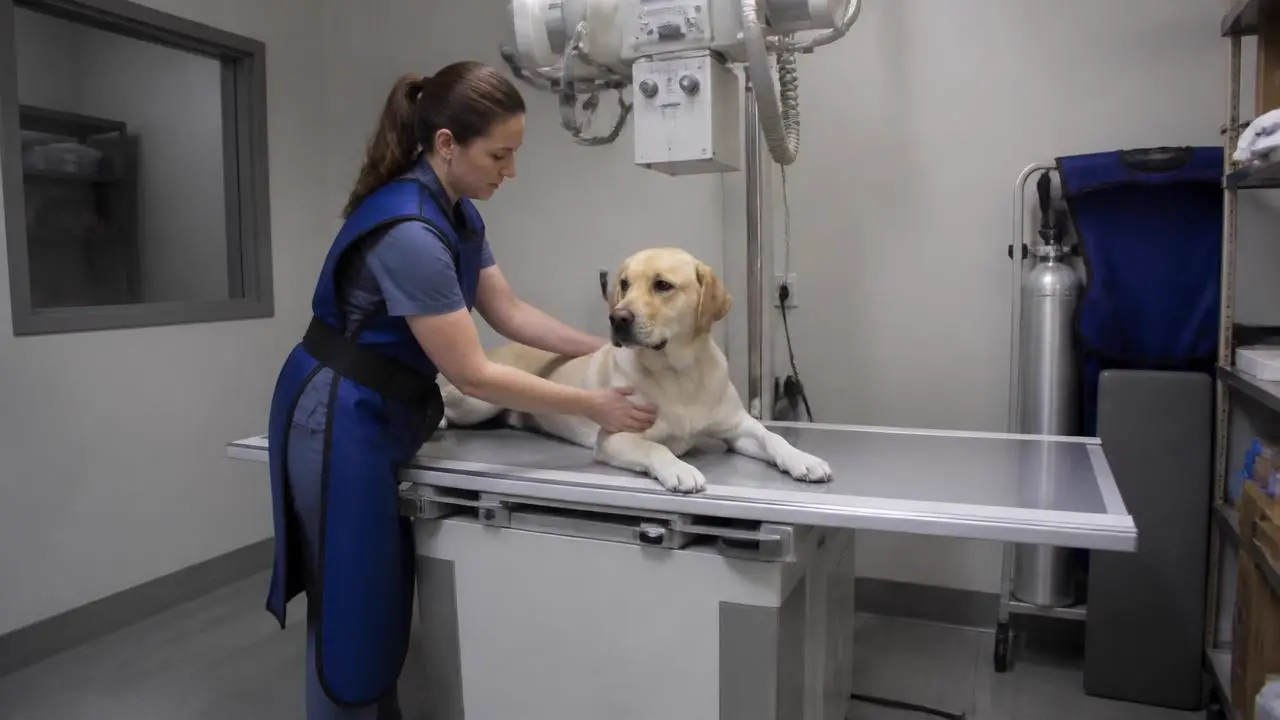
Most descriptions of veterinary teleradiology talk about minutes: a one hour STAT turnaround, a 24 hour routine window. Minutes are real, but they are not what a practice manager notices walking the floor. What changes is who does what, when a case is allowed to move, and whether a client conversation happens with an answer or with a guess. The clearest way to show that is to walk through one day.
Key takeaways
- The delay in most practices is not radiologist availability, it is the queue of decisions waiting on an interpretation nobody in the building has time to give.
- Uploading a study should be a two-minute technician task, not a doctor's job squeezed between appointments.
- A same-day written report changes the client conversation from a placeholder to an answer, which is what clients actually remember.
- Reliable formal reads tend to increase imaging capture rates, because doctors stop skipping studies they cannot confidently read alone.
- The referral decision gets easier, not harder, when a radiologist's impression names the trigger clearly instead of a hedge.
- Track turnaround, capture rate, and same-day resolution rate monthly. Averages hide the case that hurt you.
7:40am: the morning ortho drop-off
A seven month old Labrador comes in for a scheduled lameness workup, non-weight-bearing on a rear limb for four days. This is the easy case to get wrong, not because the radiographs are hard to take, but because the interpretation genuinely matters to the surgical plan and most general practitioners are not comfortable calling subtle physeal or OCD findings on their own.
Where the delay used to live
In a practice without a reliable remote read, this study either sits until the one doctor comfortable reading orthopedics has a gap, or it goes out as a referral for imaging that could have been done in-house. Both cost the same thing: a full day, sometimes two, before the owner hears anything concrete.
Who does what now
- The technician acquires three views, checks them for motion and collimation, and uploads immediately, before the patient leaves the table.
- The submitting doctor adds a one-line history: age, duration, weight-bearing status, and the specific question, orthopedic versus developmental.
- The study is flagged routine, not STAT, because no decision in the building is waiting on it within the hour.
- A written report is back before the patient's afternoon recheck slot, so the discharge conversation includes an actual differential list.
11:15am: the vomiting dog nobody can stage
A five year old terrier mix comes in vomiting for two days, not eating, mildly painful on abdominal palpation. This is the case that used to eat the middle of the day: is it a foreign body, is it pancreatitis, does it need to be hospitalized for fluids and repeat films, or can it go home with an antiemetic.
Appointment and hospitalization flow
The doctor takes three-view abdominal radiographs between the next two scheduled appointments and marks the study STAT, because the decision to hospitalize or send home is sitting in front of the client in the exam room. A one hour STAT turnaround means the doctor gets an answer before the appointment block closes, not after the client has already left uncertain.
The decision this actually enables
- If the radiologist calls a mechanical obstruction pattern, the dog is hospitalized and surgery is scheduled the same afternoon instead of after a second visit.
- If the pattern is nonspecific and gas distribution is benign, the dog goes home with symptomatic treatment and a recheck, and the exam room slot is not held open on uncertainty.
- If the read is genuinely equivocal, the radiologist's report says so explicitly and recommends ultrasound, which is a clear referral or in-house next step rather than a guess dressed up as a plan.
See the companion piece on turnaround time versus accuracy for how a provider's speed should be evaluated against exactly this kind of decision, not against a generic average.
Free for veterinary teams
The one-day workflow map
A single-page map of exactly who touches an imaging study at each step, from acquisition to client conversation, that you can adapt to your own practice's roles and shift patterns. Ask and we will send it.
- A role-by-role checklist for acquisition, upload, and follow-up
- STAT versus routine flagging criteria your team can apply consistently
- A same-day client communication script for pending versus completed reads
No contracts. No minimums. Radiologists on shift every day of the year.
6:00pm: the collapsed cat at the worst hour
A twelve year old cat is carried in collapsed, tachypneic, at the exact hour when the day doctor is finishing charts and the evening shift is thinner. This is the hour that exposes whether a practice's imaging support is real or theoretical.
Where the delay really comes from here
It is rarely the radiograph itself. Thoracic films take minutes. The delay comes from needing a confident read on pleural effusion versus cardiomegaly versus a mass, at an hour when the doctor on the floor is managing triage for three other patients simultaneously and does not have the bandwidth to be the second opinion on their own films.
- The study is submitted STAT with a specific question: cardiac versus pulmonary versus pleural space.
- The radiologist's report drives an immediate decision on thoracocentesis, oxygen support, or stabilization before further workup, inside the hour.
- The client conversation happens with the owner still in the building, which is the conversation that determines whether they agree to hospitalization or transfer.
11:30pm: the overnight ER handover
A dog hit by a car arrives after hours and is stabilized by the overnight team, who take thoracic and pelvic films and need to decide whether the patient can wait until morning for surgical consultation or needs to be transferred to a 24 hour facility tonight.
Staffing and coverage, not marketing language
This is the case that separates a provider with staffed overnight radiologists from a provider who calls a contracted overflow reader at 3am "24/7 coverage." The difference is not cosmetic. A genuinely staffed overnight service reads the study on the same clock the ER team is working on, and the morning shift inherits a settled plan instead of a pending study and a guess made at midnight.
The handover itself
- The overnight technician uploads the study with a brief trauma history: mechanism, vitals, and exam findings.
- The written report and, where needed, a phone conversation with the reading radiologist informs whether the patient is stable to hold or needs transfer.
- The morning doctor opens the file with a completed report already attached, not a study still marked pending.
This is also where a second set of eyes earns its keep on complex trauma, as covered in our piece on second-reader value. Overnight decisions made alone carry more risk than the same decision made with a radiologist's report in hand.
Who actually uploads, and who should not have to
Across all four cases above, the pattern repeats: the person who acquires the study should also be the one who sends it, and it should not require a doctor to stop and do it themselves. Practices that route uploading through whoever happens to be free lose consistency and lose studies in inboxes.
| Role | Responsibility | Common failure point |
|---|---|---|
| Technician or assistant | Acquires views, checks quality, uploads with history attached | Study sent without duration, medications, or a specific question |
| Submitting veterinarian | Sets STAT versus routine flag, states the clinical question | Everything flagged urgent, which degrades the STAT queue for real emergencies |
| Front desk or client liaison | Relays the completed report to the owner same day | Report arrives but sits unread until the next appointment |
| Practice manager | Owns the monthly metrics review and provider relationship | No one owns it, so problems are noticed only after a complaint |
Revenue and imaging capture rates
There is a quieter effect that shows up on the P&L rather than the exam room clock. Practices that trust their imaging interpretation tend to order the studies their equipment is capable of, instead of defaulting to "let's just refer this out" or, worse, treating empirically without imaging at all because nobody on staff is confident reading the film.
- Under-ordering shows up as low radiographs-per-visit ratios on cases that clinically warranted imaging.
- Over-referring shows up as sending imaging-appropriate cases to a specialty hospital that could have been managed with a same-day formal read plus in-house treatment.
- Both leave revenue and case continuity on the table, and both are addressed by the same fix: a dependable, fast formal read that the doctor can act on without a second-guessing conversation.
None of this argues against referral when a case genuinely needs it. It argues for making that decision on a radiologist's stated impression rather than on a doctor's uncertainty about whether they read the film correctly.
The PACS and DICOM plumbing underneath all of it
Every scenario above depends on a boring fact: the study has to leave your modality in standard DICOM format and arrive intact, with patient and study metadata attached, without a technician manually re-typing anything.
What a practice actually needs
- A digital radiography or ultrasound system capable of exporting standard DICOM, which nearly all systems sold in the last decade can do.
- A send path, whether a DICOM push to the provider or a secure upload portal, that a technician can operate without IT support mid-shift.
- A place to attach history and a clinical question alongside the images, not as a separate email or phone call.
- A way for the completed report to land back in the patient's record automatically, rather than as a PDF someone has to remember to file.
You do not need a hospital-grade PACS to start this. Practices with an existing PACS get automated routing and archiving, which is a convenience, not a prerequisite. Guidance from the AVMA and AAHA on medical record standards is a reasonable starting point if you are formalizing this for the first time, and veterinary imaging programs such as those at Cornell's College of Veterinary Medicine publish useful reference material on DICOM workflow in clinical settings.
Metrics a practice manager should pull monthly
None of the changes above are visible unless someone is measuring them. A short monthly pull, not a dashboard project, is enough.
| Metric | Why it matters | Target range to watch for drift |
|---|---|---|
| Percent of STAT studies read within 60 minutes | Exposes queue problems before they become a bad case | Above 90 percent, tracked by count not average |
| Percent of routine studies read within 24 hours | The everyday reliability number | Above 95 percent |
| Studies rejected or queried for missing views or history | Shows how much delay your own submission process is generating | Under 5 percent, trending down |
| Radiographs per relevant visit | Tracks under-ordering or over-referring imaging you could capture | Compare month over month, not to an external benchmark |
| Same-day client resolution rate | The client experience number that correlates with retention | Rising, or stable at a high level |
| Referral rate driven directly by radiologist impression | Confirms referrals are decision-driven, not uncertainty-driven | Stable or explainable by caseload, not by staff turnover |
None of the four cases above required a different building, different equipment, or a different clinical team. What changed across the day is where the waiting happened. Instead of a patient waiting in a cage, an owner waiting by the phone, or a doctor waiting for a spare minute that overnight shifts do not have, the wait moved to where it belongs: a defined, short interval between submitting a study and receiving a report a doctor can act on.
If you want to see how this looks against your own caseload, talk to us about a trial run, or read more about how we structure coverage and quality on our about page. You can also start from the home page for an overview of turnaround commitments and coverage hours, or reach us directly at +1 888-303-RADS or Info@RadsForVets.com to walk through your own day, case by case.
Frequently asked questions
Work with us
Board-certified reads, 1 hour STAT, every day of the year
No contracts, no minimums, and direct access to the radiologist reading your case.